
Entry doors and lobby glass
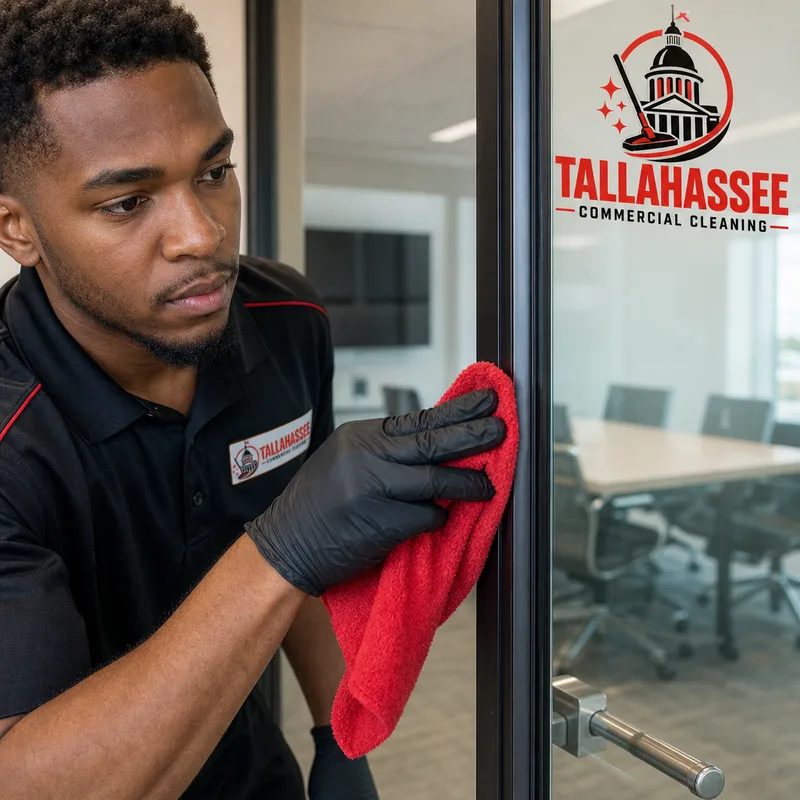
The first surface anyone sees and the one that shows handprints fastest. Glass, frames, and the surrounding floor band get attention on every visit.
Serving Tallahassee, Florida & surrounding areas
Mon–Fri 8am–6pm · Sat 9am–2pm
Restaurant cleaning service in Tallahassee
Branch lobbies, teller lines, ATM vestibules, and back offices cleaned by a stable crew working inside your access and security rules.
Cleaning inside a controlled building
A branch is a small building with an unusually high appearance standard at the front and unusually tight control at the back. The lobby is read closely by people deciding whether to trust the institution with their money, and the areas behind the teller line are governed by rules that have nothing to do with cleaning.
Those rules shape the work before the first task is written. Who may enter which room, when, escorted or unescorted, and what happens to anything left on a desk are all decided by your policy rather than by a cleaning schedule. A crew that does not understand that creates a problem on the first night.
The appearance standard runs the other direction. Glass, counters, and floors in a lobby are looked at under bright, even lighting by people with nothing to do while they wait. Smudges on an entry door, dust on a counter edge, and a scuffed floor lane register far more than they would in a warehouse or a back office.
We write the scope around both: a documented, stable crew who work inside your access rules, and a front-of-house standard that holds up to the way a lobby is actually looked at.
Where attention concentrates
The building splits into zones with different standards and different access rules, so the scope is written zone by zone.
Each zone gets its own frequency and its own access note, so the schedule says who can be where and when, not just what gets cleaned.
Nothing in the scope requires a crew member to move documents, handle equipment behind the counter, or enter a secured area alone unless your own policy explicitly allows it.
Scope by area
A branch is read from the entry door inward, so the areas a customer sees carry a different standard from the areas only staff use.
The first surface anyone sees and the one that shows handprints fastest. Glass, frames, and the surrounding floor band get attention on every visit.
Counter tops, edges, and fronts, transaction surfaces, and the touch points customers and staff share across the line.
Floors, glass, and machine surrounds in the part of the building that stays accessible outside banking hours and shows wear accordingly.
Rooms where accounts are opened and documents are signed, cleaned around a clear-desk rule with nothing moved or handled.
Break rooms, work rooms, and staff restrooms behind the counter, cleaned under your access rules by the same assigned crew.
The walked lane from the entry to the counter, kept to an even appearance with periodic restoration scheduled before wear becomes visible.
Access before tasks
The access arrangement gets settled first, because it decides what the schedule can look like.
Before scope, we go through your access rules, camera coverage, alarm procedure, and whether work happens escorted or on a code. Everything after this is built on that answer.
The same small crew is assigned to your branch, documented by name, and background-checked. Changes to that list are told to you rather than discovered by you.
We walk from the entry inward, noting the appearance standard each zone carries and the access rule attached to it, and write both into the scope.
Lobby and floor work goes where it will not meet customers. Back-of-house work goes where your access rules allow it. The result is a schedule that holds week to week.
After the first few weeks we walk the branch with your manager and tighten anything where the written standard and the expected standard were not the same thing.
Budget range
Tallahassee's published range runs from about $200 to $1,200+ a visit by size and frequency; a single branch usually lands low to mid in that span, since the buildings are small. A branch with an ATM vestibule, multiple offices, and daily service sits higher than a small office of the same square footage.
The drivers specific to this kind of building are frequency, the amount of glass and counter frontage, whether the ATM vestibule is included, how much of the work has to happen outside banking hours, and what your access rules require in terms of escorting. Escorted work costs more than work a documented crew can do on a code, because it occupies your staff as well as ours.
Lobby floor restoration is usually quoted separately from the recurring scope, since it runs on its own cycle rather than weekly. We confirm the figure after walking the branch.
Access and scope
We start from your access rules rather than from a standard task list, so the schedule we propose is one your policy actually permits.
What branch managers ask
The first conversation with a bank is rarely about tasks. It is almost always about who is in the building and under what conditions.
A named, background-checked crew assigned to your branch, not a rotating pool. You get the list, and if it has to change we tell you before the change happens rather than after you notice an unfamiliar face on camera.
That is your decision, not ours. We work either way: escorted during or after hours, or unescorted on an access code where your policy allows it. Escorted work needs more lead time and usually costs more, because it occupies your staff too.
Nothing. We do not move, stack, read, or clear papers, and we do not touch screens or equipment behind the teller line. If a desk is covered, the desk surface is skipped and noted rather than cleared to be cleaned.
The walked lane from the entry to the counter wears faster than the rest of the floor and is the part customers look at. It gets regular attention in the recurring scope, with periodic restoration scheduled before the wear pattern becomes visible rather than after.
Yes, when it is in the scope. It is worth including: it stays accessible outside banking hours, takes weather and foot traffic the lobby does not, and is often the only part of the building some customers ever see up close.
Yes. We set the alarm procedure during the walk-through, including who holds codes, what the sequence is on entry and exit, and who gets called if something does not respond as expected. It goes in writing, not into one person's memory.
Start with your access rules
Tell us how your branch controls access and we will build the scope and the schedule around it, then walk it with you before anything starts.
Request a quote
Send the building details and we will come back with a scope and a realistic range, usually the same working day.