
Warehouse floors
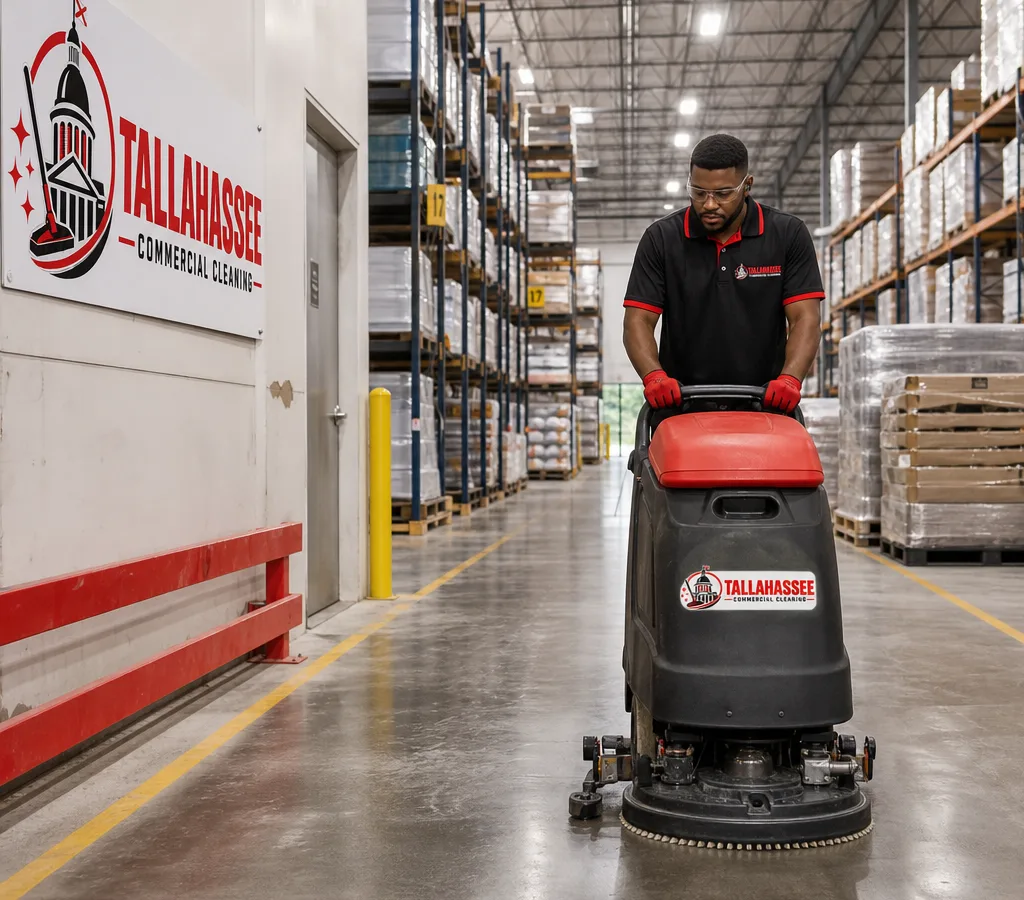
Machine scrubbing on a frequency matched to traffic volume, with attention to lanes, edges, and the areas under and around racking.
Serving Tallahassee, Florida & surrounding areas
Mon–Fri 8am–6pm · Sat 9am–2pm
Restaurant cleaning service in Tallahassee
Warehouse floors, dock areas, break rooms, and attached offices cleaned around the shifts your operation actually runs.
Serving Midway from Tallahassee
Midway's commercial space leans toward warehousing, distribution, and light industrial use, and in those buildings the floor is not one item on a checklist. It is the surface that determines whether the building reads as well run, and it is the one that takes constant abuse from wheeled traffic and anything tracked in through a dock door.
Dock soil behaves differently from office dust. It is coarse, it arrives in quantity, and it gets ground into concrete by forklift and pallet-jack traffic before anyone has a chance to sweep it. A cleaning schedule written for carpeted offices does not touch this problem.
The attached office and break areas sit at the other extreme: ordinary commercial space that still needs an ordinary commercial standard, usually in the same visit, usually by the same crew, often with a shift running in the building the whole time.
We cover Midway from our Tallahassee base. The scope that works here is built around machine floor work on a frequency that matches traffic, with office and break areas handled on a conventional schedule alongside it.
Where the work goes
The building splits into zones that wear at completely different rates, so the frequencies differ sharply across one scope.
Edges, corners, and the areas under racking need separate attention from the open floor, because a machine pass down a lane does not reach them and they are where a floor visibly ages.
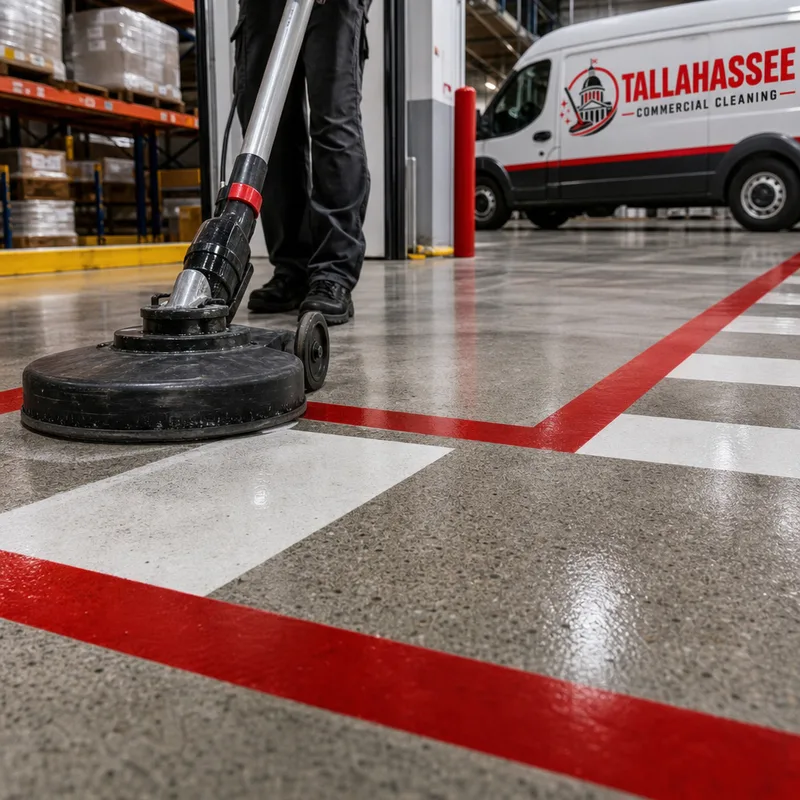
Where safety striping or marked walkways exist, keeping them legible is part of the floor scope rather than an extra: faded striping is a safety matter before it is an appearance one.
Scope by area
Industrial buildings carry several standards at once, from a dock that only needs to be functional to an office that is seen by visitors.
Machine scrubbing on a frequency matched to traffic volume, with attention to lanes, edges, and the areas under and around racking.
The band inside each dock door where tracked soil concentrates, cleaned often enough that it does not migrate through the rest of the building.
Floor and surface cleaning around equipment, scheduled around production so the work does not interrupt a running line.
High-use shared space needing consistent frequency, including tables, seating, appliance exteriors, and floors.
Fixtures, floors, partitions, and consumables on a frequency that matches headcount rather than square footage.
Standard commercial cleaning for the administrative side of the building, covering desks, shared surfaces, and entries.
Working around operations
A facility that runs shifts has no empty window by default, so the schedule gets designed rather than assumed.
We walk the floor while it is working, because the traffic pattern, the dock activity, and the areas that genuinely cannot be touched mid-shift only show up when the building is running.
Shift changes, down periods, and the hours a given zone is clear go on the schedule first. Floor machine work gets placed where it does not meet moving traffic.
Lanes, docks, break areas, restrooms, and offices get their own frequencies, because applying one frequency across the building overserves some areas and underserves others.
PPE requirements, restricted areas, lockout procedures, and who signs the crew in are settled before the first visit, not negotiated on the night.
Floor condition is the honest measure here. We walk it with you after the routine settles and adjust the machine frequency if the wear pattern says we got it wrong.
Budget range
Conventional buildings around Tallahassee typically fall between about $200 and $1,200+ a visit; larger facilities and heavier industrial schedules commonly sit above that. Industrial square footage is cheaper per foot than office square footage but there is usually a great deal more of it.
For this kind of building the drivers are floor area and surface type, how much of it needs machine work rather than sweeping, dock count, restroom and break-room count against headcount, and how much of the schedule has to fit a narrow window between shifts.
Periodic work is quoted separately because it runs on its own cycle: deep floor restoration, high-level dusting on racking and structure, and post-project cleanup after a line change or build-out. The final number follows a walk-through taken while a shift is running.
Scope and schedule
We write the frequency zone by zone and place the disruptive work where it will not meet your operation.
What facility managers ask
Most of these come from managers who need to know the cleaning will not become a problem for the operation it is supposed to support.
Yes, with the work placed by zone. Break areas, restrooms, and offices can be done while the building operates. Machine floor work needs a clear lane and drying time, so it goes into a quiet window or a shift change. We map those windows before quoting.
Yes. Machine scrubbing is the only practical way to maintain industrial concrete at scale, and the frequency is matched to how much wheeled traffic the lanes take rather than to a standard interval.
Yes. PPE requirements, restricted zones, and sign-in procedures are settled during the walk-through and written into the scope. If your facility requires specific training or orientation before anyone works on the floor, we complete it first.
Yes, and it usually makes sense in one contract. The office and the warehouse need different frequencies and different standards, so they are written as separate parts of one scope rather than averaged into a single schedule.
That is periodic work rather than part of a recurring visit. It needs equipment, a planned shutdown of the affected area, and its own quote. We schedule it on a cycle that fits your operation rather than attempting it alongside routine cleaning.
Yes. That is post-construction scope rather than recurring cleaning: dust removal through the whole affected area, floor reset, and detail work before the space goes back into use. It is quoted per project.
Facility coverage
We will walk the building during a working shift and write a scope around your floor, your docks, and your schedule.
Request a quote
Send the building details and we will come back with a scope and a realistic range, usually the same working day.